Voltage, Current and Resistance
8 मिनट
Every working circuit needs a source of electrical energy, a complete path, and a load that uses that energy. Three quantities describe what is happening: voltage, current, and resistance.
Voltage: the push
Voltage is the difference in electrical potential between two points. A 5 V battery provides about five volts between its positive and negative terminals. Think of voltage as the push that can move charge around a closed circuit. It is measured in volts (V).
Current: the flow
Current is the rate at which electric charge flows. It is measured in amperes (A), often in milliamperes (mA). One ampere is 1,000 milliamperes. A circuit must be closed for steady current to flow.
Resistance: the opposition
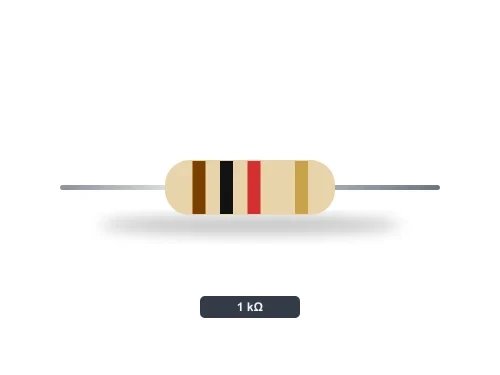
Resistance describes how strongly a component opposes current. It is measured in ohms (Ω). A resistor adds a known amount of resistance.
Ohm’s law
For many simple resistors: V = I × R. Rearranging gives I = V ÷ R and R = V ÷ I. For example, 5 V across a 1,000 Ω resistor gives I = 5 ÷ 1,000 = 0.005 A, or 5 mA. If resistance doubles while voltage stays the same, current halves.
Try it
Find the current through a 2,200 Ω resistor connected to 5 V: I = 5 ÷ 2,200 ≈ 0.00227 A, or 2.27 mA. Check your units.
Safety
Practice with low-voltage batteries or a current-limited classroom supply. Never experiment with wall outlets. Never connect a battery’s positive and negative terminals directly: a short circuit can heat wires and damage the battery.
Key idea
Voltage is the push, current is the flow, and resistance limits that flow. Ohm’s law connects all three.
Voltage pushes current
The voltage is the push; current moves through the closed path.