
LEDs and Current-Limiting Resistors
8 मिनट
An LED (light-emitting diode) makes light when current flows through it in the correct direction. LEDs are useful indicators, but too much current can damage them. A resistor in series limits that current.
Polarity
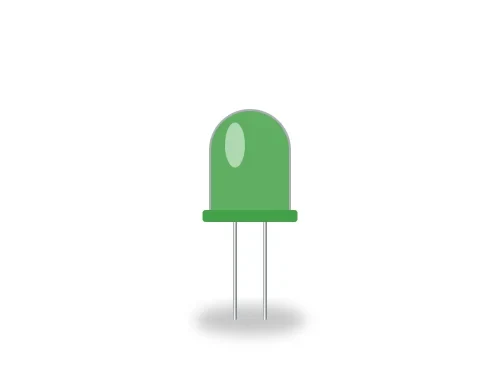
An LED has an anode (+) and cathode (−). On a new through-hole LED, the longer leg is usually the anode; the shorter leg and flat edge on the body mark the cathode. If connected backwards in a low-voltage circuit, it usually will not light. Check reused parts against their markings or datasheet.
Choosing a Resistor
Use Ohm’s law. The resistor voltage is the supply voltage minus the LED’s forward voltage: R = (Vs − Vf) ÷ I. A typical red LED may have Vf around 1.8–2.2 V. Choose a modest current such as 5–10 mA for a beginner circuit; the LED datasheet gives its limits.
Worked Example
With a 5 V supply, a red LED with an estimated 2 V forward drop, and a target current of 5 mA: R = (5 − 2) ÷ 0.005 = 600 Ω. Choose the next common value above this, such as 680 Ω. The actual current is roughly (5 − 2) ÷ 680 ≈ 4.4 mA. A 1 kΩ resistor is also a safe, bright-enough starting point for many indicator LEDs.
Build It
Connect battery positive to a resistor. Connect the resistor to the LED anode. Connect the LED cathode to battery negative. The resistor and LED can swap order in a single series path; what matters is that both are in the same path and the LED polarity is correct.
What Not to Do
Never connect an LED directly across a battery or supply without a current-limiting component. Do not assume a microcontroller pin can safely provide unlimited current. When driving multiple LEDs, calculate each branch current and check the board’s total current limits.
Troubleshooting
If the LED does not light, disconnect power. Check polarity, loose wires, breadboard rows, and battery voltage. Try a known-good LED. If the LED is very bright or hot, disconnect it and increase the resistance.
Check Your Understanding
Why does the resistor matter? It sets a safe current. For a 9 V supply and a 2 V LED at 7 mA, R = (9 − 2) ÷ 0.007 = 1,000 Ω. A 1 kΩ resistor is a suitable starting choice.
Safety
Use a low-voltage battery or current-limited supply. Never use household mains power for this activity.